
DEEP GUIDE · ADVANCED
WORD Generation (@vword)
Learn @vword AI drafting, full and partial insertion, revision review, tables and equations, and DOCX, PDF, and VORA export.
VORA Chat and Tool Demo
WORD Generation (@vword) — workflow demo
Learn @vword AI drafting, full and partial insertion, revision review, tables and equations, and DOCX, PDF, and VORA export.Choose a real request from this guide and preview the flow from input to result.
This demo stays in your browser; it sends, saves, and charges nothing.
Send a request to see the processing flow and output format for this tool.
@vword Write English meeting minutes with a table of decisions, owners, and deadlines
- 1Check request scope
- 2Create draft or session
- 3Prepare dedicated workspace
- 4Return new-tab URL
VORA chat input@vword Write English meeting minutes with a table of decisions, owners, and deadlines
https://guide.vora.im/en/tools/word-generation/#workspace-demoOpen in a new tab ↗ ⓘ Check the live link card in VORA for its expiry. The preview shows the Korean interface.
Live results vary with the source material, request, and time of use.
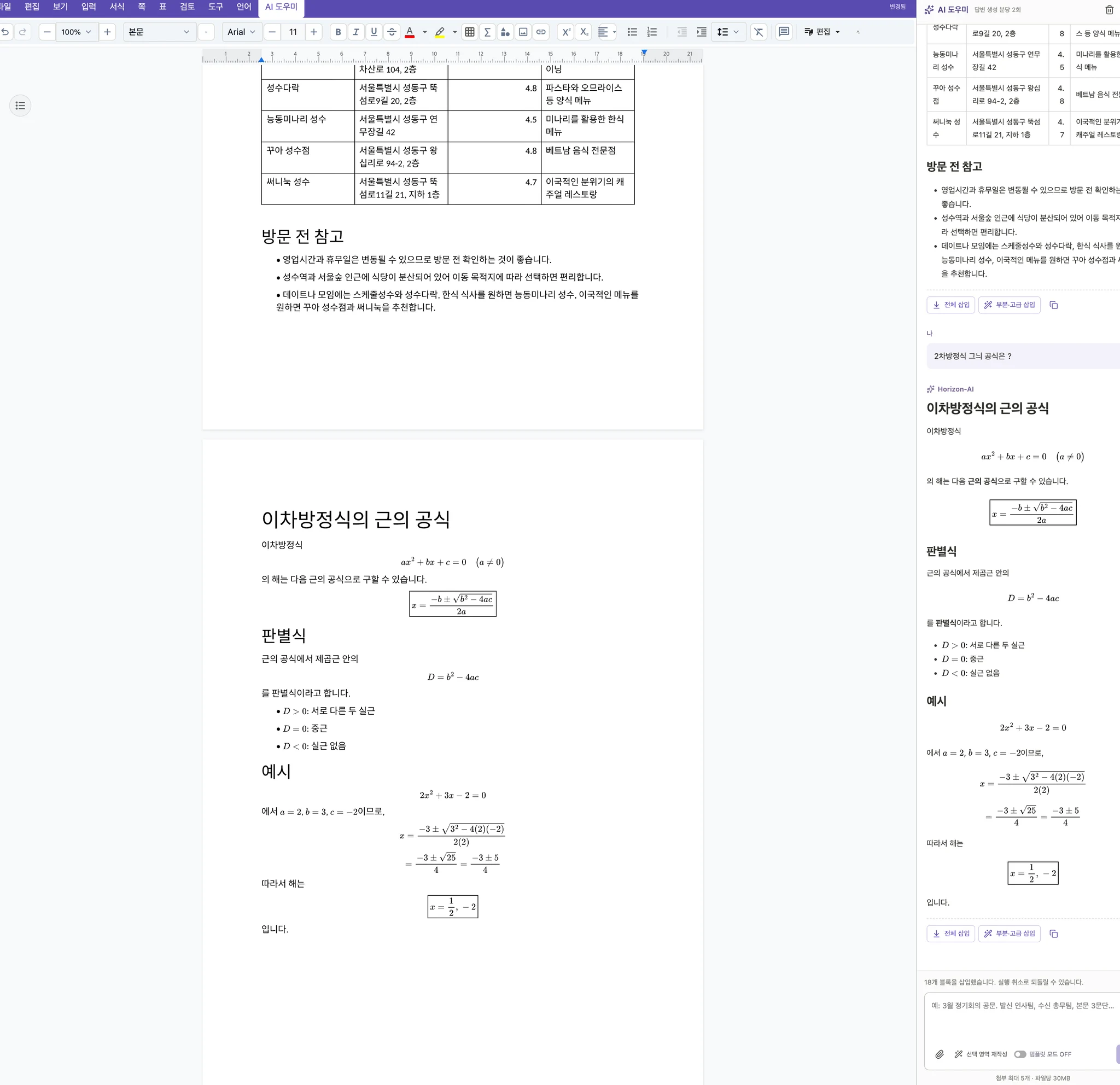
01. From drafting to DOCX export
WORD Generation opens an AI document editor with @vword. Draft reports, minutes, and letters, or open a DOCX to edit text, tables, images, and page layout. Review AI responses before inserting them.
02. Start with @vword
| Chat input or action | What opens |
|---|---|
| @vword | An empty editor when no request, background, or attachment is supplied. |
| @vword Turn the discussion above into meeting minutes | The editor starts AI drafting with the request and conversation background. |
| @vword Summarize https://example.com/reference.pdf as a report | An accessible HTTPS file URL is read as reference material before drafting. |
| File → Open, then select DOCX | Opens the existing DOCX for editing, separately from reference analysis. |
03. Requests to try
Specify the purpose, audience, language, length, and required sections. Supply names, dates, and figures, and ask to leave missing information blank.
- @vword Write English meeting minutes with a table of decisions, owners, and deadlines
- @vword Create a worksheet explaining the quadratic formula with equations and worked examples
- @vword Write a two-page report from the attachments with a summary and next actions
04. Editor layout and controls
Use the File, Edit, View, Insert, Format, Page, Table, Review, Tools, and Language menus. The AI assistant opens beside the document. Scroll long toolbars with the arrow controls.
- Click to place the cursor or drag to select text.
- Adjust character and paragraph formatting, then fit the view to width or one page.
- Find commands with Ctrl/Cmd+Shift+P and compare edits with undo and redo.
05. Use document context and attachments
Ask about the current document or selection in the AI panel. Add references by file picker, drag and drop, or file URL. The default limit is five files of 30 MB each; follow the limits shown in the interface.
06. Full and partial insertion
- Read the AI response and check its facts and figures.
- Use full insertion for the entire response or partial/advanced insertion for selected blocks.
- Confirm the insertion location and any transformation such as summary, formal wording, table, or list.
- Check tables, equations, images, and line breaks after insertion. One undo reverses that insertion.
07. Rewrite and review a selection
Select text within one paragraph and request a rewrite, such as shortening it while preserving meaning and numbers. Compare the original and suggestion, apply the proposed change, then accept or reject it from Review.
08. Refine tables, equations, and paragraphs
Use Table commands to add rows and columns, merge or split cells, set borders, distribute widths, and repeat header rows. Check fractions, scripts, line breaks, and spacing around AI-generated equations.
09. Images, media, charts, and citations
Insert media from the image/video/chart URL command or an AI response. Images become document assets; YouTube uses a thumbnail and link, while other video uses a title and link. Web charts and mind maps use an image and original link.
10. Templates and page setup
Create a letter, minutes, or report from File → New from template. Use Insert and Page for headers, footers, page numbers, paper, margins, and breaks. Open existing DOCX files through File → Open.
11. DOCX, PDF, VORA, and recovery
- Export DOCX for further editing or PDF for distribution and printing.
- Wait for VORA save confirmation, then find the file in My AI Creations.
- Use File → Document recovery and version history to inspect browser-stored drafts.
- Reopen the DOCX and PDF to check fonts, equations, tables, page breaks, and links.
12. Troubleshooting and final checks
| Situation | Next step |
|---|---|
| Expired link or access failure | Request a fresh @vword link in VORA. |
| Weak supporting evidence | Check attachment extraction, selection, and request scope. |
| Tables, equations, or images look different | Adjust widths, margins, and fonts, then reopen the saved file. |
| Undo an insertion | Undo, change the location or selected blocks, and insert again. |
Review content and evidence, then tables and equations, page layout, and reopened DOCX/PDF files before handing them over. Compare AI-written names, dates, and figures with the source.