
HWP Generation
Learn @vhwp drafting, review and fill existing HWP/HWPX template fields, edit tables and pages, and export HWP, HWPX, and PDF.
VORA Chat and Tool Demo
HWP Generation — workflow demo
Learn @vhwp drafting, review and fill existing HWP/HWPX template fields, edit tables and pages, and export HWP, HWPX, and PDF.Choose a real request from this guide and preview the flow from input to result.
This demo stays in your browser; it sends, saves, and charges nothing.
Send a request to see the processing flow and output format for this tool.
@vhwp Make a business plan draft
- 1Check request scope
- 2Create draft or session
- 3Prepare dedicated workspace
- 4Return new-tab URL
VORA chat input@vhwp Make a business plan draft
https://guide.vora.im/en/tools/hwp-generation/#workspace-demoOpen in a new tab ↗ ⓘ The live editing link is valid for a limited time.
Live results vary with the source material, request, and time of use.
What is the HWP Generation tool?
A tool that creates Hangul (HWP) documents.
Based on your request and the previous conversation context, it automatically writes an HWP document, and you can freely refine the content using AI features in the editing screen that opens in a new tab. The completed document can be saved as HWP, HWPX, or PDF, and is fully compatible from legacy to the latest HWP versions.
Use it for tasks where Hangul is the standard — government and public institution submission documents, school reports, business plans and proposals based on Korean templates.
When can you use it?
The HWP Generation tool is especially useful in these situations.
- When you need a template document to submit to government or public institutions
- When you want to write school assignments or reports in Hangul format
- When you need standard Korean business documents like business plans or proposals
- When you want to quickly create a Hangul document draft based on conversation context or materials
For example, you can naturally ask "@vhwp Make a business plan draft", "@vhwp Organize the meeting above as meeting minutes", or "@vhwp Format this as an application form". The AI will then use this tool to create an HWP document session and provide a link to the external editing screen.
How to use it
This tool only works when you enter the @vhwp trigger keyword first, followed by the content of the document you want to create.
The format is as follows:
@vhwp + [Content of HWP document to create]
Here are some examples:
- Business plan: "@vhwp Make a business plan draft"
- Meeting minutes: "@vhwp Organize the meeting above as meeting minutes"
- Application/Proposal: "@vhwp Format this as an application form"
- School report: "@vhwp Make a 5-page school report on environmental protection"
Editing screen preview
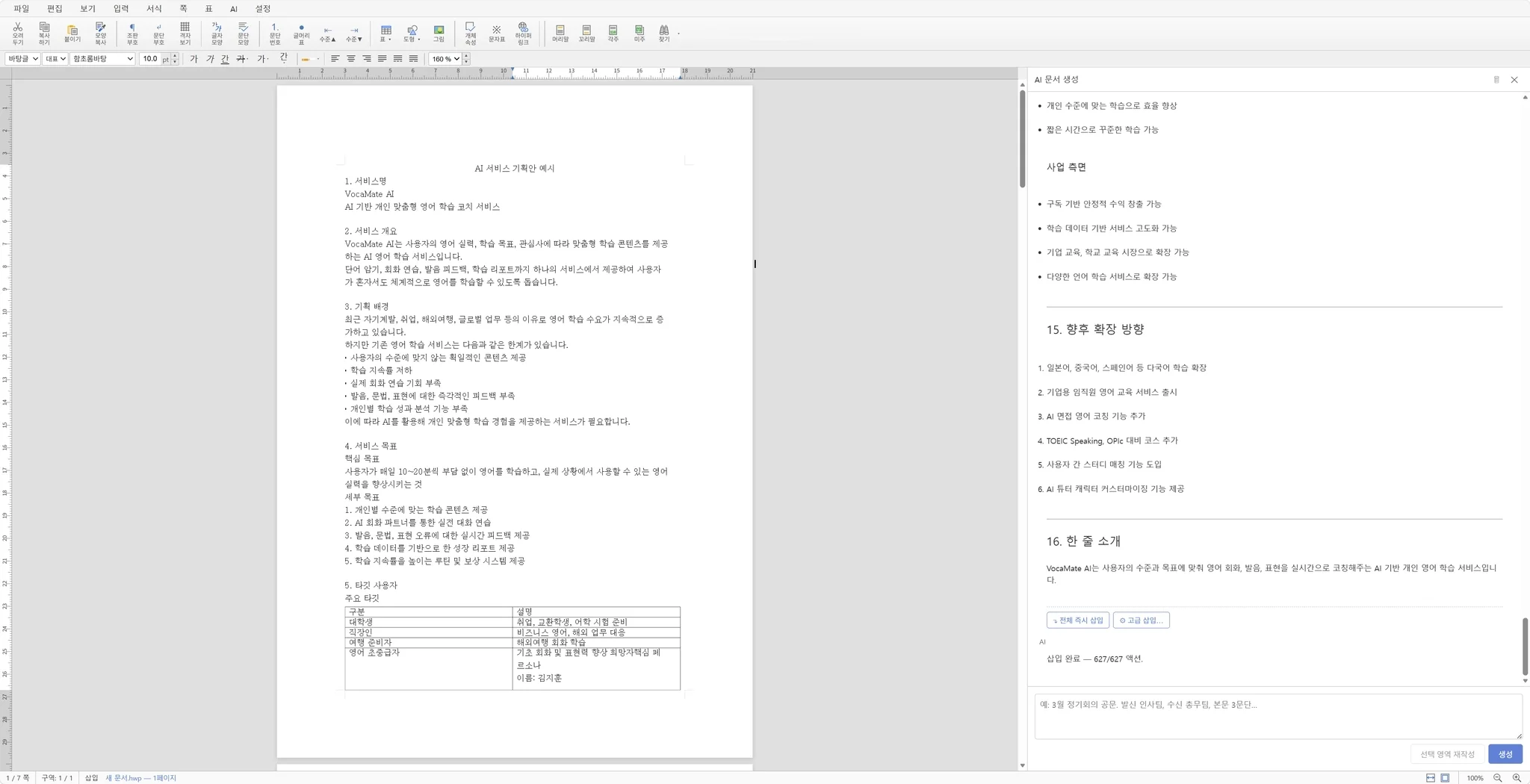
The editing screen that opens in a new tab provides the standard HWP editing environment and an AI assistant together on a single screen. You can edit the body on the left while using AI features in the right sidebar to generate and refine content.
You can freely use the following four features.
📝 Standard HWP editing
You can use the familiar Hangul tools as-is — File, Edit, View, Insert, Format, Page, Table, AI, Settings menus, along with character/paragraph styles, tables, shapes, images, headers, footers, footnotes, and more. You can work directly with the Hangul templates required by government and public institutions.
🤖 AI-powered document generation
When you enter a natural language prompt in the AI Document Generation area in the right sidebar, structured content is generated per document section — one-line introduction, business aspects, future expansion plans, and more. You can reflect it all at once in the body with Insert All, or fine-tune details with Advanced Insert.
✂️ Selection rewriting
Select the part of the body you want to refine, then press the Rewrite Selection button to have the AI rewrite just that area. Useful for cleaning up wording or changing tone in part of the document while leaving the rest intact.
💾 HWP / HWPX / PDF save
The completed document can be saved as HWP (standard Hangul format), the newer HWPX format, and PDF for sharing or printing. HWP supports all versions from legacy to the latest, so it's compatible with both legacy template files and the latest version. Saved files can be opened and used directly in Hangul Word Processor, Hangul Viewer, or any PDF viewer.
💾 Saving Your Work to VORA
The editor opens in a new tab, and the editing link expires after a limited time. Once your document is ready, save it to VORA with the [내보내기(VORA)] (Export to VORA) button in the editor.
Saved files are collected under Settings > My AI Generated Files, and they stay there even after you delete the chat or the link expires.
📁 What is My AI Generated Files?
It's the space where the images, documents, and videos created while using your AI are stored. (Settings > My AI Generated Files)
- Results created in a chat expire after a while, but files saved here stay available
- Deleting a chat does not delete the files you've saved here
- Storage is capped at 200MB. Once it's full, new files can't be saved — clear out what you no longer need
※ This is different from AI Knowledge Base. AI Knowledge Base is where you upload your own documents for your AI to read and refer to when answering. My AI Generated Files is the opposite — it's where the results your AI creates are collected.
Template insertion: review and fill form fields
Use template mode for forms with fixed tables and instructions. It identifies writable fields using the existing labels, instructions, and table structure, then lets you review proposed field values before changing the document.
Open the existing HWP or HWPX form and switch Template mode ON in the AI assistant. Provide real submission details and references, then ask: “Preserve field labels and instructions, fill only the blanks, and leave unknown information empty.”
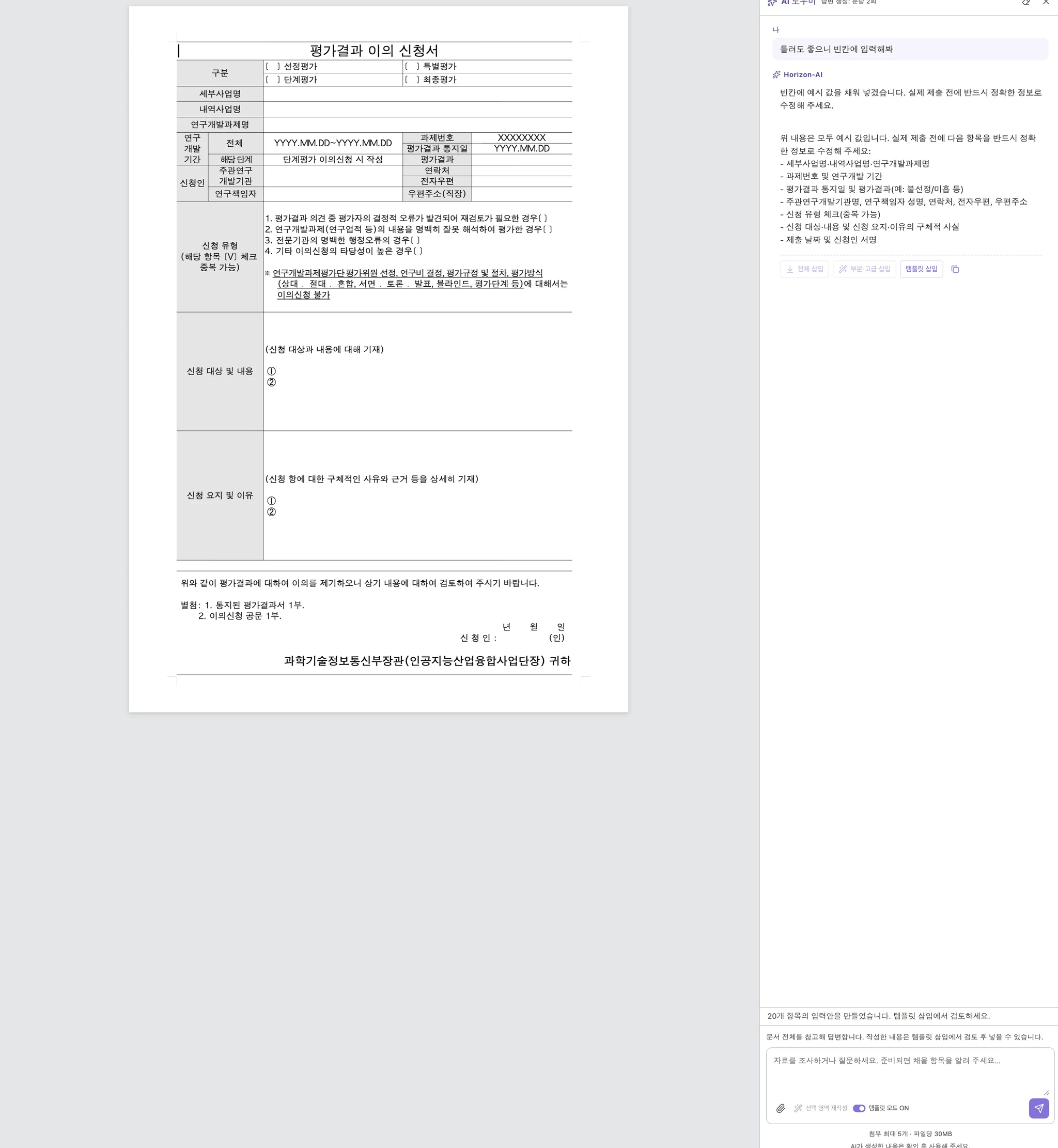
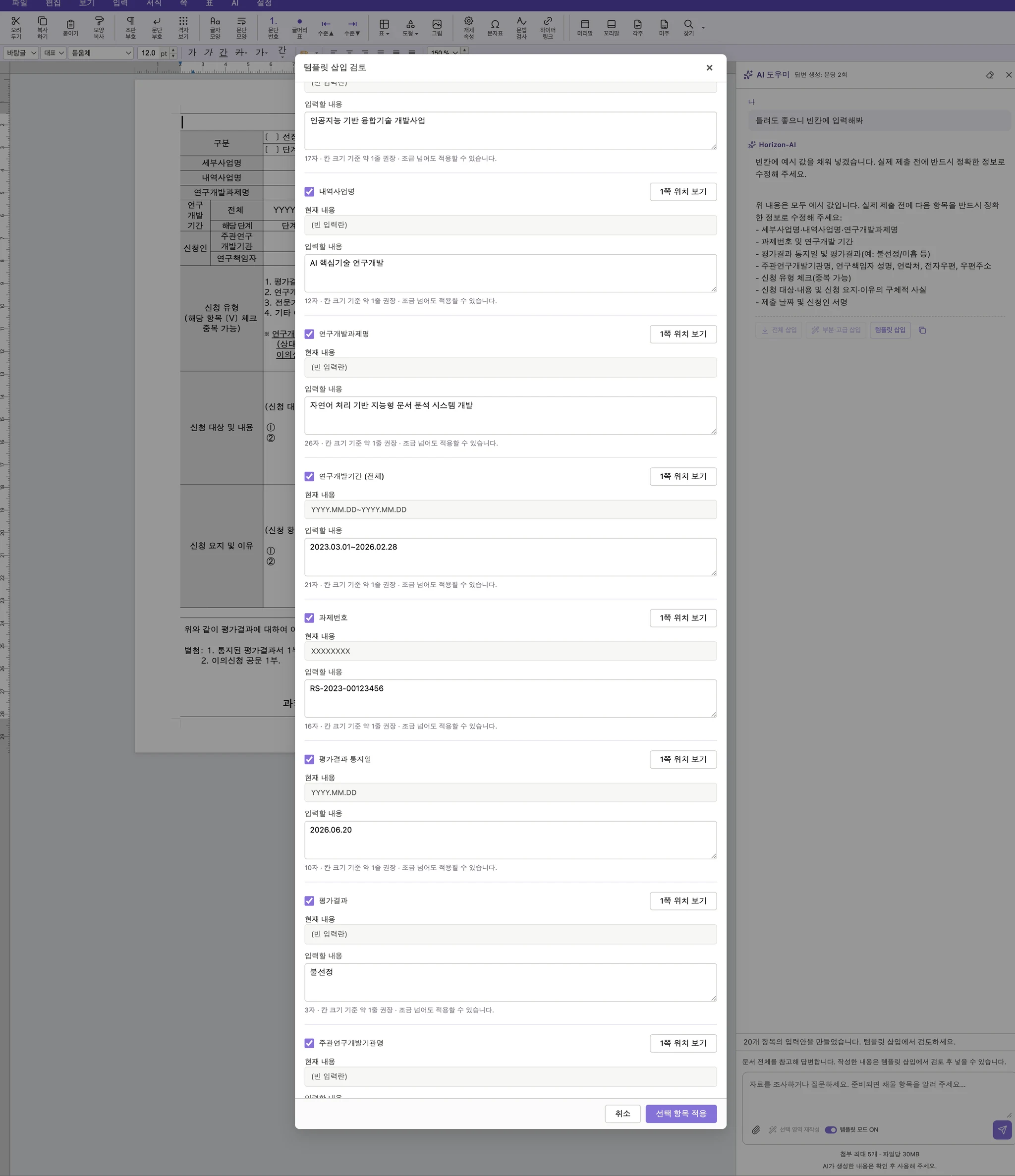
- Select Template insertion under the response to open the review dialog.
- Compare the current and proposed values for each field and edit the proposed text.
- Use View location to check the actual page and field. Uncheck any field you do not want to apply.
- Use the suggested line count to shorten text where needed, then apply the selected fields.
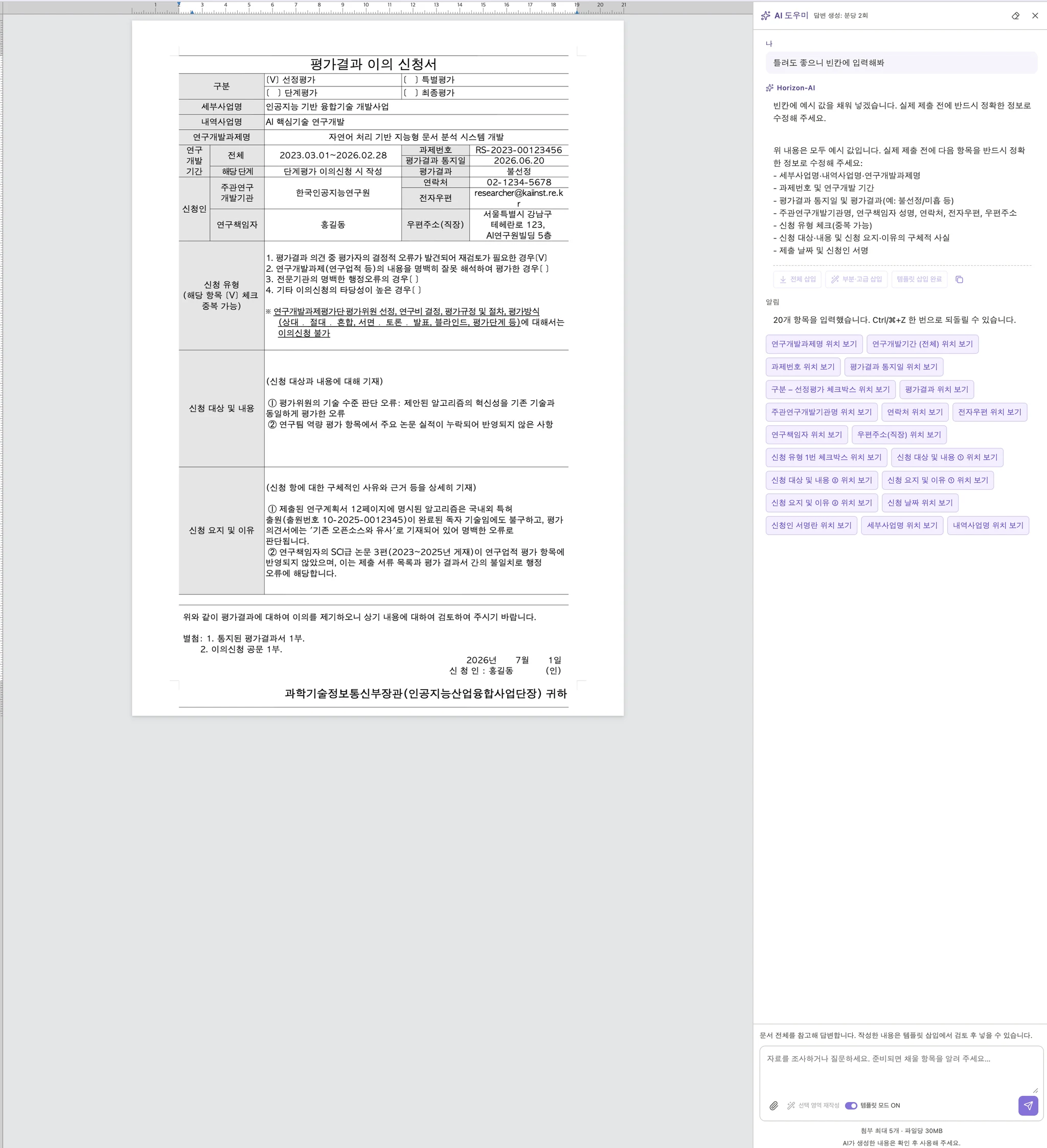
After applying, revisit filled fields with View location. Check numbered markers such as ① and ②, fixed instructions, checkboxes, and table wrapping. One Ctrl/Cmd+Z reverses the entire insertion.
Practical request checklist
For a stronger HWP Generation request, state the goal, input, scope, and output format together. Adding one more layer of constraints beyond the basic examples reduces follow-up questions and makes the result easier to use.
- Start with the deliverable’s purpose, audience, language, and real use case.
- Separate required source material, figures, and wording from content to exclude.
- Set the file type, length, outline or columns, visual tone, and definition of done.
Review, save, and reuse the result
Treat the HWP Generation result as a draft or a snapshot taken at query time. Check the following before carrying it into the next task.
- Confirm that titles, structure, tables, and figures follow the request and source material.
- Before publishing, review spelling, copyright, personal data, and brand usage.
- For revisions, name the page, paragraph, or cell and the exact change instead of regenerating everything.