
DEEP GUIDE · ADVANCED
PPT Generation (@vppt)
A 22-chapter advanced guide to the entire PPT Studio workflow—from planning and generation to text, image, chart, table, and layout editing, then presenting, sharing, and export.
01. PPT Studio at a glance
PPT Generation turns a topic and goal into an outline, slide structure, copy, images, and visual elements, then lets you refine everything in the browser. The workflow continues through presenting, narration, link sharing, and PDF or PowerPoint export.
| Stage | What you do | Key features |
|---|---|---|
| Plan | Define the audience, purpose, and message | Language, length, tone, detail, source files |
| Generate | Create an outline and draft | 1–20 slides, built-in or custom themes, AI images |
| Edit | Refine content and design | Text, images, icons, charts, tables, layout |
| Deliver | Present, share, and save | Slideshow, TTS, links, passwords, PDF, PPTX |
02. Start with @vppt and a launch link
| Chat request | What opens |
|---|---|
| @vppt | The PPT workspace, where you can manage or start presentations |
| @vppt + presentation brief | A generation screen with the topic, slide count, language, tone, and verbosity applied |
| @vppt + HTTPS file URL + generation instruction | A preview for reviewing and editing content extracted from a document, image, or video |
| @vppt + turn the content above into a presentation | A generation screen that receives the relevant conversation as source material |
@vppt is an exact routing trigger that must appear in the message. File input accepts direct HTTPS download URLs for documents such as PDF, DOCX, and PPTX; images such as PNG and JPG; and videos such as MP4 and MOV. An ordinary web-page URL is not treated as an attachment. You can review and edit extracted content in the preview before generating slides.
A generation link is valid for one hour. You can generate 1–20 slides at a time; processing time can vary with source length, file analysis, image generation volume, and service settings.
03. Write an effective generation request
Include the purpose, audience, desired conclusion, slide count, language, tone, and required elements. Decision context produces a better outline and better visuals than a broad request such as “make it look nice.”
| Element | Question | Example |
|---|---|---|
| Purpose | What should be decided or accepted? | Approve a new subscription plan |
| Audience | Who will see it and what do they know? | Product and finance executives |
| Structure | What story should it follow? | Problem → evidence → options → recommendation |
| Style | What tone and level of detail? | Concise, analytical, ten slides, English |
| Requirements | What must not be omitted? | Pricing table and three-year revenue chart |
04. Generation settings and supporting files
Set the topic, slide count, language, tone, verbosity, and extra instructions. Add supporting documents when the deck must use specific terminology, evidence, or figures.
- Slide count: match the length to the speaking time; a brief summary may need 5–8 slides, while a proposal may need 10–15.
- Language: consider both the written deck and the narration language.
- Tone and verbosity: make an executive deck conclusion-led and training material more explanatory.
- Supporting files: state which evidence matters and what should be ignored.
- Extra instructions: specify required or excluded content, notation, brand voice, and the final call to action.
05. Outline, theme, and draft generation
- Review the proposed outline for order, repetition, and missing conclusions.
- Choose a built-in theme or one of your saved custom themes.
- Start generation and wait for each slide’s title, message, and visual content.
- Review the whole narrative before editing individual elements.
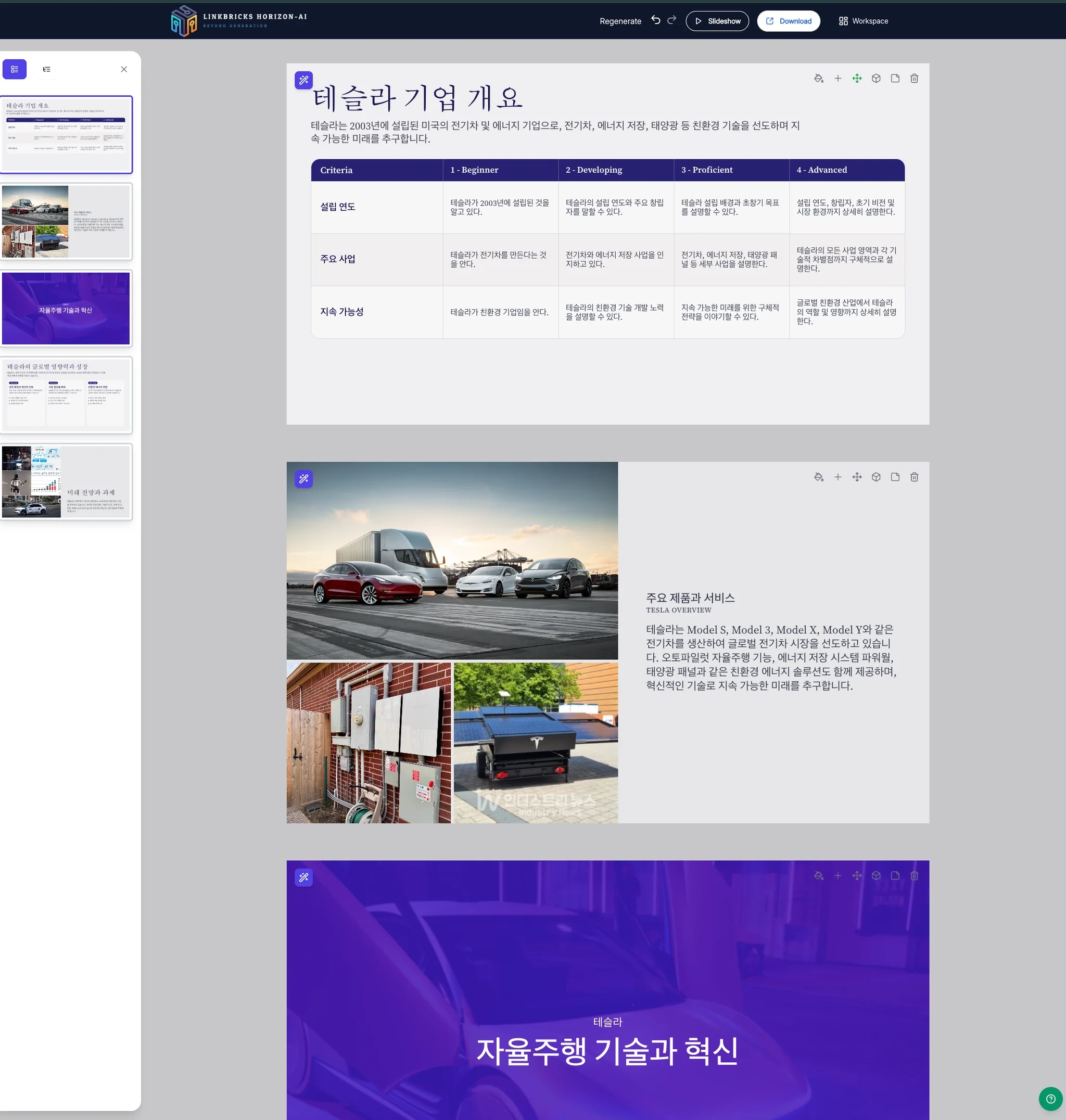
There are 13 built-in themes, and custom themes can be added. A theme affects not just color and type but the default placement of titles, body copy, and images.
06. Workspace and auto-save
| Area | Purpose |
|---|---|
| Slide thumbnails | Select, reorder, add, and review the deck’s flow |
| Canvas | Edit text, images, icons, charts, and tables |
| Top controls | Insert, undo, redo, regenerate, present, and export |
| Workspace | Manage saved decks, shared decks, and custom themes |
Edits save automatically. Returning to the Workspace saves pending changes and refreshes the deck thumbnail. Avoid closing the tab while a save is still in progress.
07. Add, reorder, and extend slides
- Reorder: drag a thumbnail in the left rail to its new position.
- New slide: use the + below a slide, then choose a suitable layout.
- New section: hover below a text or content block and press +, or choose a content type from Insert.
- Flow check: use the thumbnails to make sure each slide has a distinct job in the story.
08. Text editing and AI Rewrite
Select text to access bold, italic, underline, strikethrough, and additional formatting. Switch between normal text editing and block editing depending on whether you are revising words or a larger content region.
- Use the Type icon and normal text mode to enter text and apply inline formatting.
- Use the Box icon to edit larger text or table blocks.
- Select a text block and choose Shorten, Lengthen, or a custom instruction under AI Rewrite.
- Check that the revision preserves the meaning, numbers, and names.
09. Edit a full slide with AI
The WandSparkles control at the upper left of a slide can revise its layout, image, or text and content from a natural-language instruction.
| Target | Example instruction |
|---|---|
| Layout | “Place the primary metric large on the left and three evidence cards on the right.” |
| Image | “Replace the background with a sustainable urban logistics scene at night.” |
| Text and content | “Cut this in half for executives and add a one-line recommendation.” |
10. Replace, search, generate, and crop images
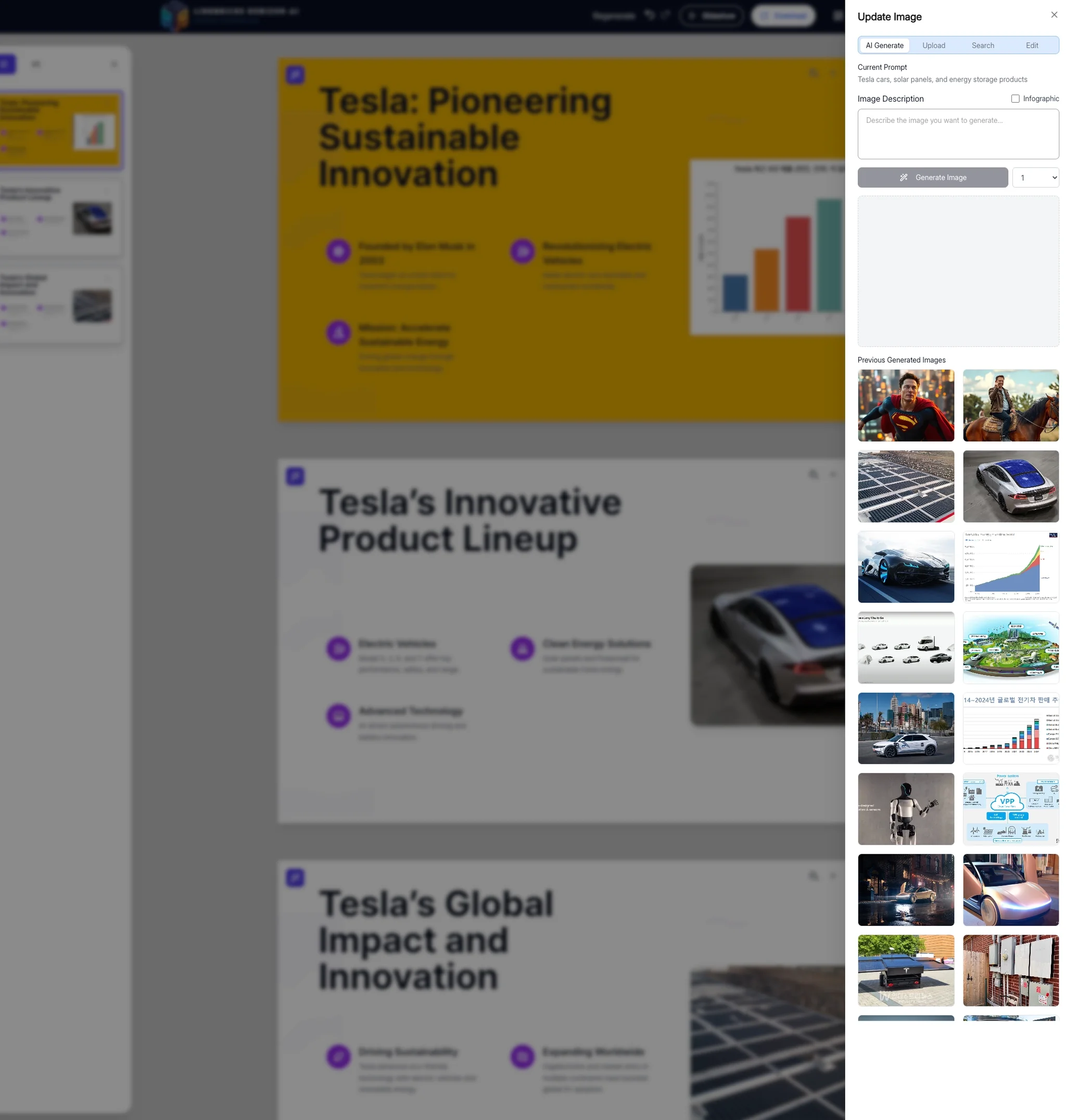
Select an image to adjust placement and fitting or replace it. Choose among search, your own upload, and AI generation based on the source you need.
- Search: open Update Image → Search, enter keywords, and apply a result.
- Upload: choose Edit → Upload to use your own photo or graphic.
- AI image: choose Edit → AI Generate and describe the scene, composition, mood, and colors.
- Infographic: turn on the Infographic option in AI Generate to produce a visual in the presentation language.
- Crop and focus: select Cover, Contain, or Fill; click the preview to set the focal point; then choose Done.
11. Create and revise AI charts
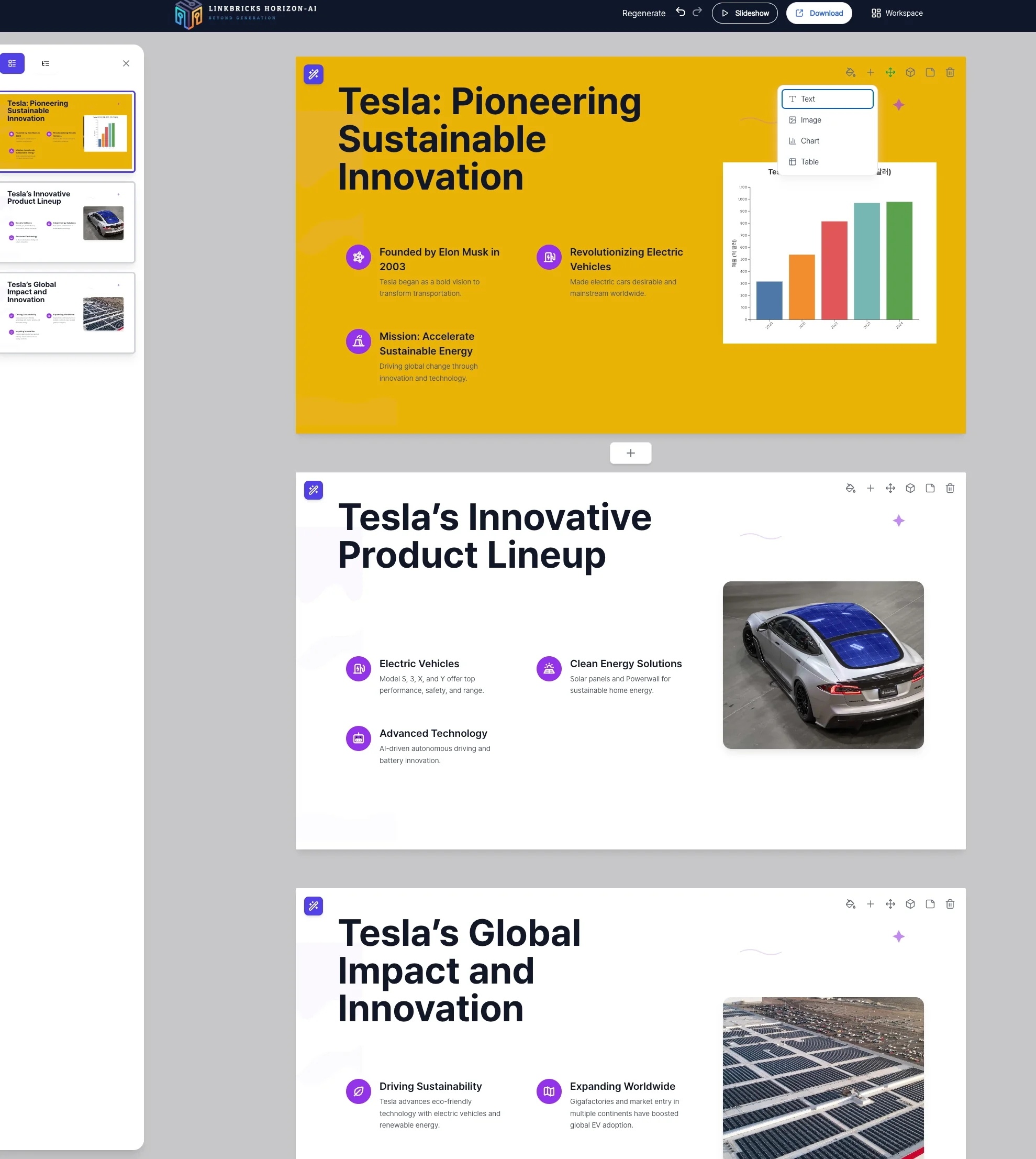
- Choose Insert → Chart.
- Describe the metric, categories, period, values, and labels.
- Name a chart type—bar, line, pie, or another suitable form—when needed.
- Move or resize the chart, or select it and use a follow-up instruction to regenerate it.
A strong request looks like: “Quarterly revenue for Products A, B, and C from 2024–2026, USD millions, highlight A, line chart.” Requests unrelated to chart data may be rejected.
Charts are overlay elements that support move, resize, delete, undo, and redo. They appear in thumbnails, preview, and slideshow, and PDF or PowerPoint export includes an image fallback.
12. Insert and edit tables
Choose Insert → Table, then drag across the grid or enter exact row and column counts. The picker starts at 10×10, expands when needed, and supports up to 50 rows by 50 columns.
- Click a cell to edit its value.
- Add or remove rows and columns where needed.
- Move, resize, or delete the table, with Undo and Redo available.
- Tables appear in thumbnails, preview, slideshow, PDF, and PowerPoint.
13. Icons and freeform layout
Select an icon to browse or search for a replacement. Use the Move control to enter layout editing, where text, images, and icons can be dragged and resized.
- Snap aligns an element to useful guides as you move it.
- Reset restores the selected element’s default position and size.
- Reset all removes every freeform layout change on the current slide.
- Delete, Undo, and Redo make layout experiments reversible.
14. Speaker notes, Undo, and regeneration
Open the note control on a slide to view, edit, and save speaker notes. Regenerate notes with AI and optionally specify the emphasis, audience level, or available speaking time.
| Control | Use it when |
|---|---|
| Undo and Redo | You are comparing recent text, element, or layout changes |
| Slide AI edit | Only one slide has a specific issue |
| Regenerate | The overall draft needs to be rebuilt from the current deck request |
15. Slideshow and presentation mode
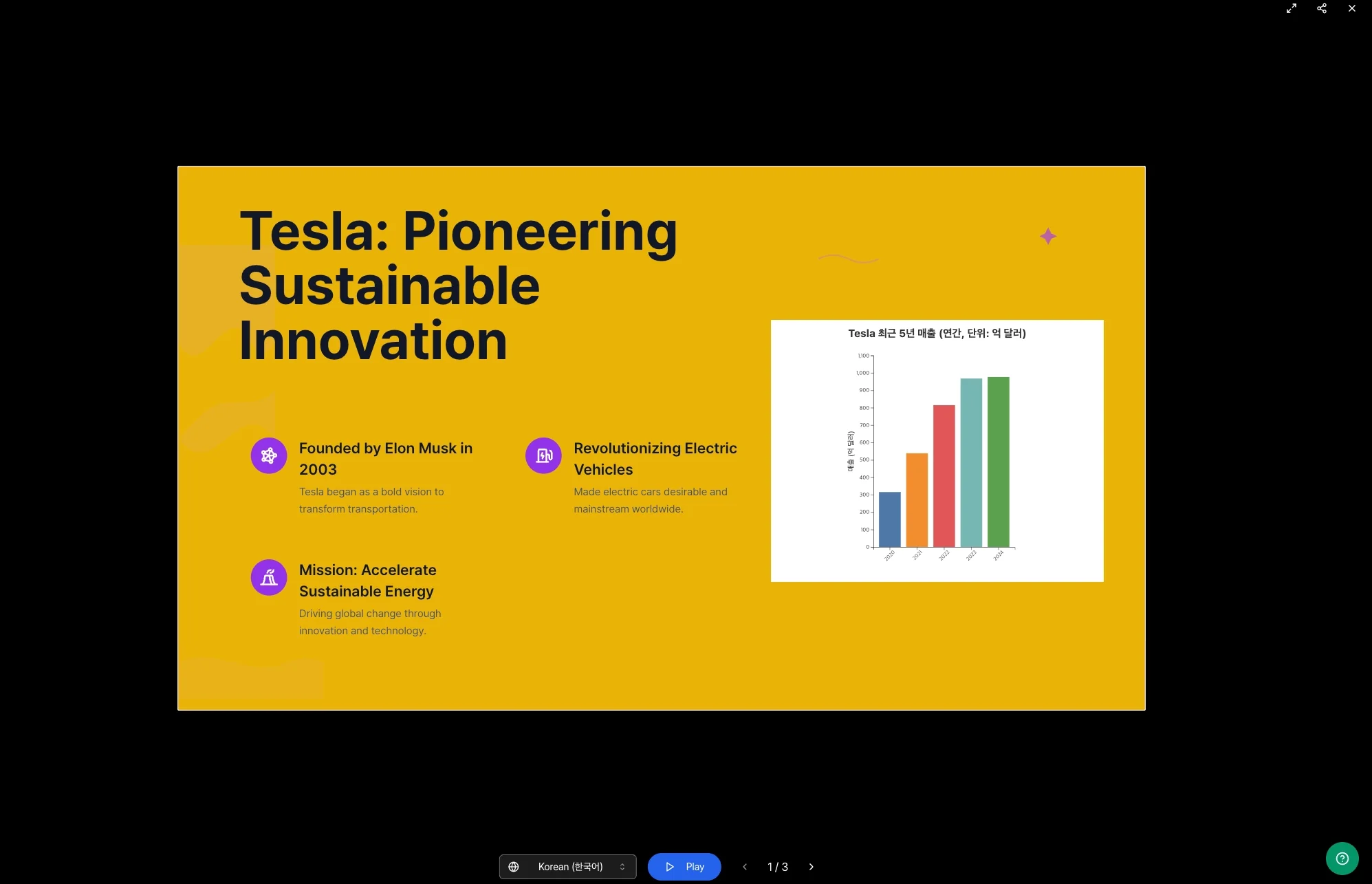
- Open Slideshow in the top bar and choose Present.
- Navigate with the arrow controls, keyboard arrow keys, or clicks on either side of the screen.
- Enter full screen and check type size and transitions in the actual presentation environment.
- Run from start to finish to catch cropped images, dense tables, note issues, and the wrong narration language.
16. Multilingual TTS narration
In Slideshow or a shared deck, choose a language below the first slide and press Play to generate narration. Around 90 languages are supported, so confirm that the narration language matches the deck.
- Your deck: open Slideshow, choose the language, and play.
- Shared deck: enter its password first when protected, then use the same TTS controls.
- Proofing: listen for abbreviations, numbers, borrowed terms, and proper names, then adjust spelling where necessary.
17. Share links and password protection
- Open Share from Slideshow or from the deck card in Workspace.
- Create and copy the read-only link.
- Add a password when needed and send it through a separate secure channel.
- Test the link, password, navigation, and TTS in a private browser window before distribution.
Viewers cannot edit the deck, but can use Present and TTS. When updating a protected link, leave the password field empty to retain the existing password or enter a new value to replace it.
18. Upload & Share and Shared Decks
Upload & Share can convert an existing PDF or PPTX into a shareable deck. Choose the file and language, run the conversion, copy its link, and optionally protect it with a password.
- Open Workspace → Shared Decks and choose Share a Deck to upload a new file.
- Open the converted deck and inspect every page, image, and line of text.
- Use the deck card to copy its link, set or change its password, or delete it.
19. Export PDF or PowerPoint and save to VORA
Use Export in the upper right to choose PDF or PowerPoint. PDF is suited to fixed-layout review and distribution; PowerPoint is suited to offline presenting and file-based follow-up editing.
| Format | Best for | Check |
|---|---|---|
| Review, distribution, and printing | Clipping, chart and table rendering, image resolution | |
| PowerPoint | Offline presenting and editing | Font substitutions, element compatibility, chart fallback images |
| Save to VORA | Finding the result under AI Creations | Successful save and the shared 200 MB storage limit |
20. Custom themes and fonts
- Open New Theme and upload the reference PDF or PPTX.
- Upload any required fonts before extraction if they are not already available.
- Process the file, extract its design, then save a name and description.
- Leave “Share with others” off for a private Workspace theme, or turn it on to make the theme available to all users.
Providing fonts first improves line breaks, scale, and visual fidelity. Test the saved theme with a short deck containing a cover, body slide, and chart before depending on it.
21. Recommended end-to-end workflow
- State the purpose, audience, and conclusion in one sentence and prepare source material.
- Open @vppt and set the language, length, tone, verbosity, and extra instructions.
- Confirm the outline and theme, then generate the draft.
- Review narrative flow and facts before design details.
- Refine text, then images, charts and tables, then icons and layout.
- Review speaker notes and TTS, and rehearse in Slideshow.
- Choose link and password sharing or PDF and PowerPoint export for the audience.
- Open the final result in an external environment before distribution.
22. Troubleshooting and final review
| Issue | What to check |
|---|---|
| Launch link does not open | If more than one hour has passed, request a new link from @vppt |
| The draft is too generic | Clarify the audience, purpose, required conclusion, sources, and verbosity |
| An image is cropped badly | Recheck Cover, Contain, Fill, and the focal point |
| The layout is broken | Use Snap, Reset for one element, or Reset all |
| A chart is not generated | Add metrics, values, categories, period, labels, and chart type |
| The exported file looks different | Check fonts and compatibility, then inspect PDF and PPTX in their target apps |
| You cannot find a feature | Search Help or filter it by categories such as Images, Charts, or Sharing |
- Facts: do figures, dates, quotations, and names match the source?
- Message: does every slide communicate one point with a clear conclusion?
- Legibility: can the type, tables, and charts be read from presentation distance?
- Access: do the link, password, sharing scope, and public-theme setting match your intent?
- Compatibility: did you test Slideshow, TTS, PDF, and PowerPoint in the final environment?